

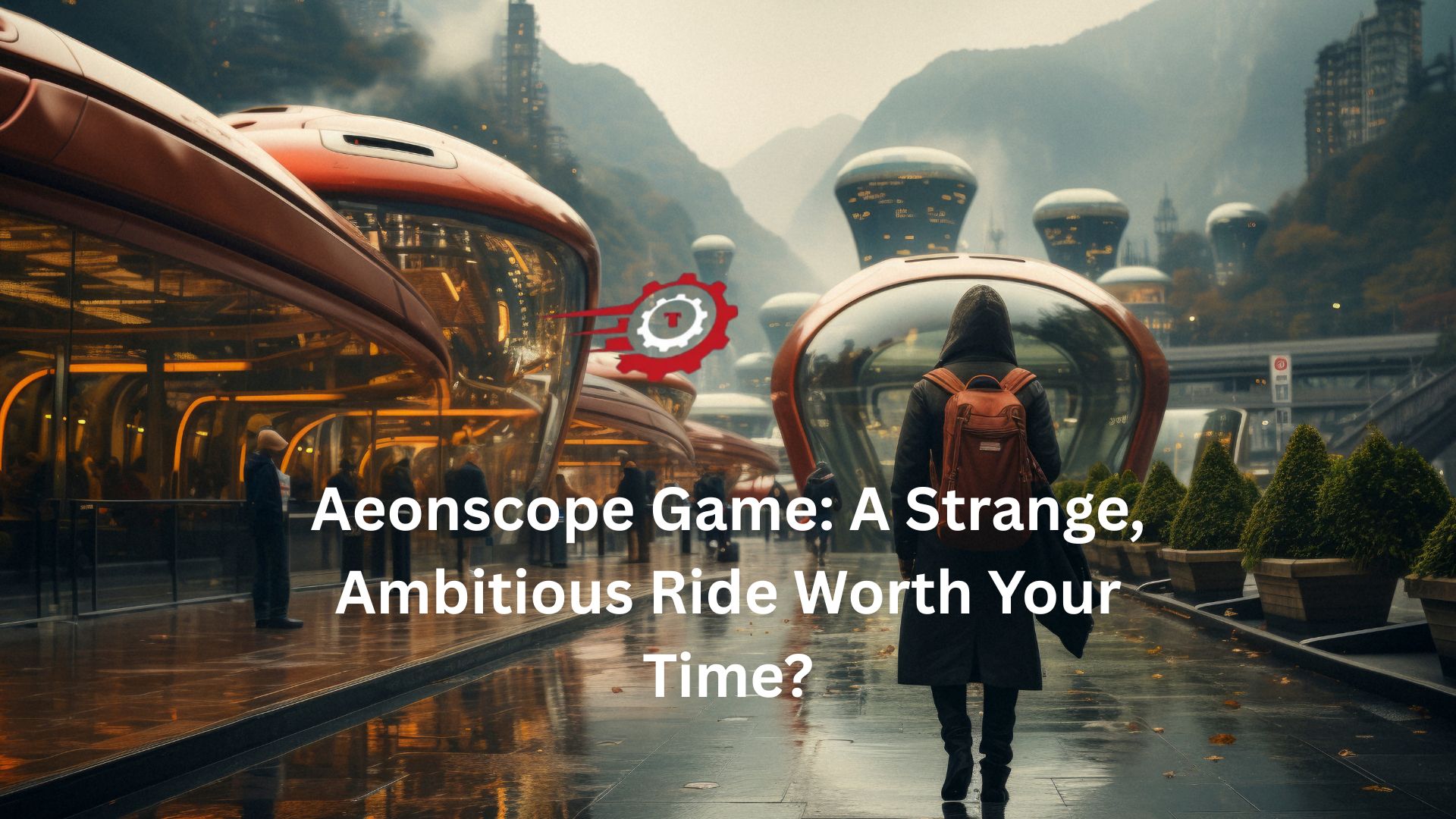
Some games ease you in. They teach you the rules, reward you early, and make sure you feel smart.
Aeonscope doesn’t really care about any of that.
It drops you into a world that feels half-finished and fully intentional at the same time. You’re not told much. You’re not guided much. And for a while, you might wonder if you’re even playing it “right.”
That confusion? It’s part of the appeal.
Aeonscope is one of those rare games that seems more interested in curiosity than comfort. It doesn’t chase trends. It doesn’t rush you. It just exists, quietly asking: how far are you willing to go to understand something that doesn’t explain itself?
A world that feels bigger than it looks
At first glance, Aeonscope doesn’t scream “massive.” The environments aren’t endless open-world landscapes. There’s no giant map covered in icons begging for attention.
But spend an hour with it, and the scale starts to shift.
Not in size, but in depth.
You’ll walk through a structure that seems simple, only to realize it connects to something you saw earlier from a completely different angle. A corridor loops back in a way that makes you question your sense of direction. A detail you ignored suddenly matters.
It’s the kind of design that rewards memory.
Here’s a small example. Imagine noticing a faint symbol etched into a wall early in the game. It doesn’t do anything. No prompt. No explanation. You move on.
Hours later, you find the same symbol again, but this time near a device that reacts when you interact with it. Suddenly, that earlier moment clicks. Not because the game told you, but because you remembered.
That’s the rhythm Aeonscope runs on.
It trusts you more than most games do
Let’s be honest, a lot of modern games are afraid of letting players get lost. There’s always a marker, a hint, or a voice telling you what to do next.
Aeonscope strips that away.
You’re expected to observe, experiment, and sometimes fail without knowing why.
That might sound frustrating. And sometimes it is. There will be moments where you wander around thinking, “What am I missing?” But when things finally make sense, the payoff feels earned in a way that guided games rarely achieve.
It’s a bit like assembling furniture without instructions. Annoying at first. Then oddly satisfying when it stands upright.
The mechanics are simple… until they aren’t
On paper, Aeonscope doesn’t seem mechanically complex. You explore, interact with objects, solve environmental puzzles, and piece together fragments of a larger mystery.
But the simplicity is deceptive.
The game builds layers quietly.
An early interaction might seem like a one-off mechanic. Later, you realize it connects to a larger system. Then that system interacts with another system. Before long, you’re juggling ideas instead of just actions.
One moment you’re flipping a switch. A few hours later, you’re thinking about timing, positioning, and cause-and-effect relationships that weren’t obvious at the start.
It never overwhelms you all at once. It just keeps adding weight slowly.
There’s a story, but you have to work for it
If you’re expecting cutscenes or long dialogues, you’ll be waiting a long time.
Aeonscope tells its story in fragments. Visual clues. Environmental changes. Small details that feel easy to miss.
And here’s the thing. The story doesn’t sit neatly on the surface. It hides in patterns.
You might notice that certain areas feel abandoned in a specific way. Or that objects are arranged too deliberately to be random. Or that something in the environment shifts after a certain action, but not in an obvious way.
Put enough of those pieces together, and a narrative starts to form.
Not a loud one. A quiet, unsettling one.
It’s the kind of storytelling that sticks with you later, when you’re not even playing. You’ll find yourself replaying moments in your head, connecting dots you didn’t see at the time.
The atmosphere does a lot of heavy lifting
Some games rely on action. Others rely on dialogue.
Aeonscope leans heavily on atmosphere.
There’s a stillness to it that can feel almost uncomfortable. Not empty, just… quiet in a way that makes you pay attention.
Sound design plays a big role here. Subtle hums, distant echoes, and occasional shifts in audio create tension without ever being loud about it.
You might be walking through an area that looks calm, but something in the sound tells you to slow down. To look closer.
Lighting also does a lot of work. Not in a flashy way, but in how it guides your eyes. A faint glow in the distance. A shadow that feels slightly off. These small details become cues, even if you don’t realize it right away.
It’s not always comfortable, and that’s the point
There will be moments where Aeonscope feels slow. Maybe even frustrating.
You’ll backtrack. You’ll second-guess yourself. You’ll try things that don’t work.
And sometimes, you’ll just sit there thinking, “Am I overthinking this?”
The answer is usually yes… and no.
That tension between simplicity and complexity is where the game lives.
It doesn’t rush to validate your decisions. It lets you sit with uncertainty. And while that won’t work for everyone, it creates a very specific kind of engagement.
You’re not just playing. You’re trying to understand.
Small details matter more than you think
One of the most interesting things about Aeonscope is how it trains your attention.
Early on, it’s easy to overlook small details. A pattern on a wall. The position of an object. A slight variation in structure.
But over time, you start noticing more.
And once you start noticing, you can’t stop.
Suddenly, everything feels intentional. Even the things that seem decorative at first glance.
It changes how you play.
Instead of rushing forward, you slow down. You look around. You test ideas.
It’s a subtle shift, but it completely changes the experience.
Who this game is really for
Aeonscope isn’t for everyone. That’s not a criticism. It’s just honest.
If you prefer clear objectives, fast pacing, and constant feedback, this might feel too vague or too slow.
But if you enjoy figuring things out on your own, if you like games that trust your intelligence, and if you don’t mind sitting with unanswered questions for a while, it hits differently.
Think of it like a puzzle that doesn’t tell you it’s a puzzle.
Or a book where some pages are missing, and you have to guess what was there.
That kind of experience isn’t mainstream, but it’s memorable.
The moments that stick
What makes Aeonscope stand out isn’t any single feature. It’s the moments it creates.
That moment when you realize two distant areas are connected.
That moment when a mechanic suddenly makes sense after hours of confusion.
That moment when you notice something small that changes how you see everything else.
These aren’t scripted highs. They’re personal discoveries.
And they hit harder because the game doesn’t force them.
Final thoughts: it’s not about winning
Here’s the thing about Aeonscope. It doesn’t feel like a game you “beat.”
It feels like something you experience.
You move through it, you learn its language, and you slowly piece together what it’s trying to say. Or maybe what it wants you to feel.
Some players will walk away frustrated. Others will be completely absorbed.
If it clicks with you, though, it really clicks.
Not because it’s perfect, but because it’s confident enough to be different.
And in a space where so many games try to guide, reward, and entertain as quickly as possible, Aeonscope does something rarer.
It asks you to pay attention.
